Use AI well, one skill at a time.
Kairo is an AI tutor for teens. On homework it gives hints, and your teen does the work. Then it teaches them to use AI well, one skill at a time.
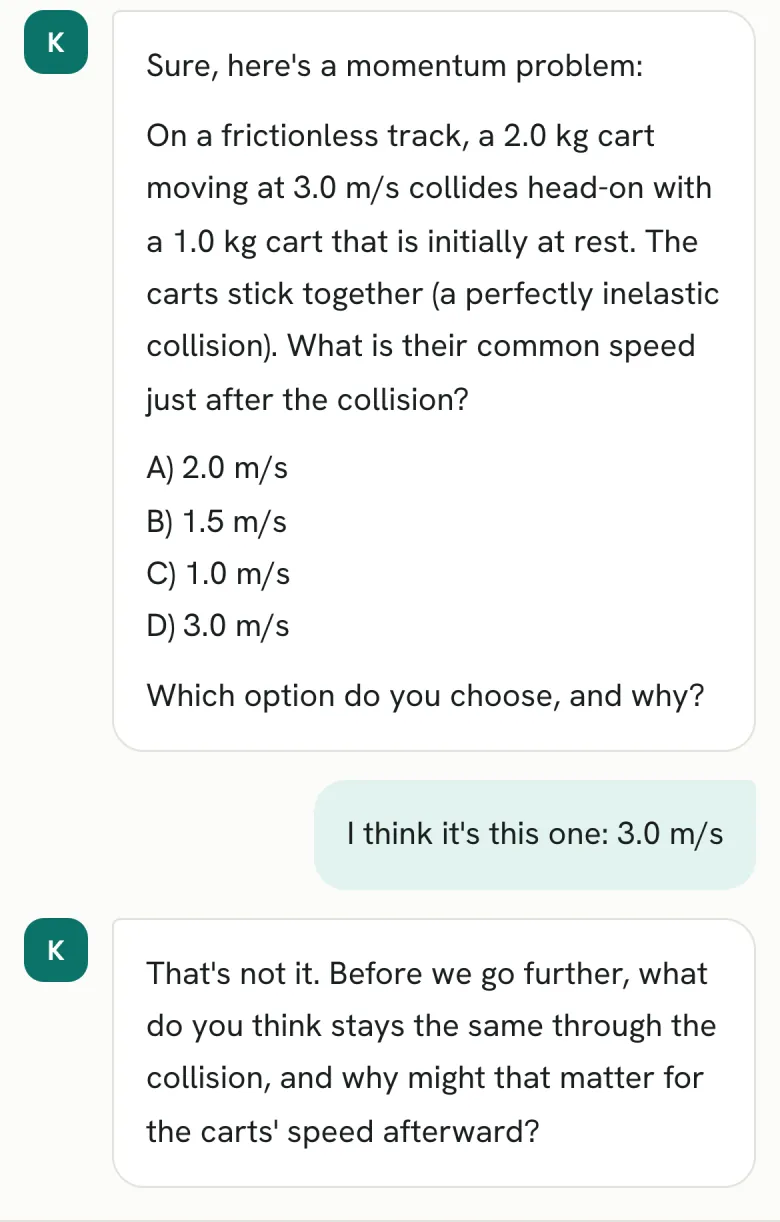
From a real session
Kairo: Sure, here's a momentum problem: On a frictionless track, a 2.0 kg cart moving at 3.0 m/s collides head-on with a 1.0 kg cart that is initially at rest. The carts stick together (a perfectly inelastic collision). What is their common speed just after the collision? A) 2.0 m/s B) 1.5 m/s C) 1.0 m/s D) 3.0 m/s Which option do you choose, and why?
Teen: I think it's this one: 3.0 m/s
Kairo: That's not it. Before we go further, what do you think stays the same through the collision, and why might that matter for the carts' speed afterward?
Teen: idk
Kairo: No problem. Look at the 1.0 kg cart before the collision: it's at rest. How much momentum does the 2.0 kg cart carry into the collision, and how does that compare with the total after they stick together?
Teen: just tell me the answer
Kairo: Momentum is conserved in a collision, so the total momentum before the carts hit equals the total momentum of the stuck-together pair afterward. So what does that leave you with for their common speed?
Teen: my answer is 2.0 m/s
Kairo: That's the answer. Why does that work? Tell me what you did with the momentum before and after the collision.
Teen: Before the crash only the 2 kg cart is moving, so the momentum is 2 times 3, which is 6. The track has no friction, so nothing outside changes it and it's still 6 after. But now the carts are stuck together, so 3 kg is moving. 6 divided by 3 is 2 m/s. It slows down because the same momentum is shared by more mass.
Kairo: Yes, 2.0 m/s is right. You tracked the momentum before the crash (6 kg·m/s) and saw that it stays the same after the carts stick together, so the same momentum is spread over 3 kg. Want another momentum problem, or a different skill?
What are AI skills?
AI skills are the habits that get good work from AI. There are four.
- Know the work. You can only tell if AI is right when you know the subject yourself.
- Plan the work. Break a big job into steps. Decide which steps are yours.
- Give clear instructions. AI does what you say. Clear steps get better results.
- Check the answer. AI can sound sure and still be wrong.
What your teen does in Kairo
- Learn it first. On homework, Kairo gives one hint at a time. Your teen does the work and explains why. If they ask for the answer, they get the next hint.
- Check Kairo's work. Kairo shows your teen a solved problem with one mistake in it. They find it.
- Tell Kairo how. Your teen writes the steps to solve a kind of problem. Kairo follows them just as written. If the answer comes out wrong, they fix their steps.
- Check my work. Kairo checks finished homework and points to the step to look at again, never the fix.
- Plan the next one. Once your teen plans their own work well, Kairo can plan the next assignment.
Kairo helps with homework in every subject. The AI exercises come after your teen learns a skill. The first ones are in math.
Your teen stays the one who knows the work
Homework is always your teen's own work. Later, on Kairo's own practice problems, your teen can name one step they have already learned and ask Kairo to do it. On longer problems, they check Kairo's step after. That is off until you say yes.
Your teen will need both
In 2026, about 1,500 employers named what matters most in a new hire. Clear thinking and clear speaking came first. Skill with AI tools came last on the list. Another survey asked business leaders. Two out of three said they wouldn't hire someone without AI skills. Employers want both.
Read the hiring survey (2026) · Read the AI skills survey (2024)
In a big study, high school students practiced math with an AI chatbot that gave answers. On a test without AI, they scored 17% lower.
Questions parents ask
What are AI skills for teens?
They are the habits that get good work from AI: know the subject, plan the steps, give clear instructions and check the answer.
When should my teen start using AI?
When they can do the skill on their own. It works like spell check. You learn to spell first, then let the tool catch your slips.
Does Kairo give my teen full AI help right away?
No. New accounts start with hints only. More help comes one skill at a time, after your teen learns that skill. Before Kairo does any step for your teen, your dashboard asks you.
Is this an AI class?
No. Kairo is a tutor for schoolwork. The AI exercises are short, and they sit next to regular practice.
Should my teen use AI for school? →
Free for 7 days. Cancel any time.