Help at 10pm. A plan before every test.
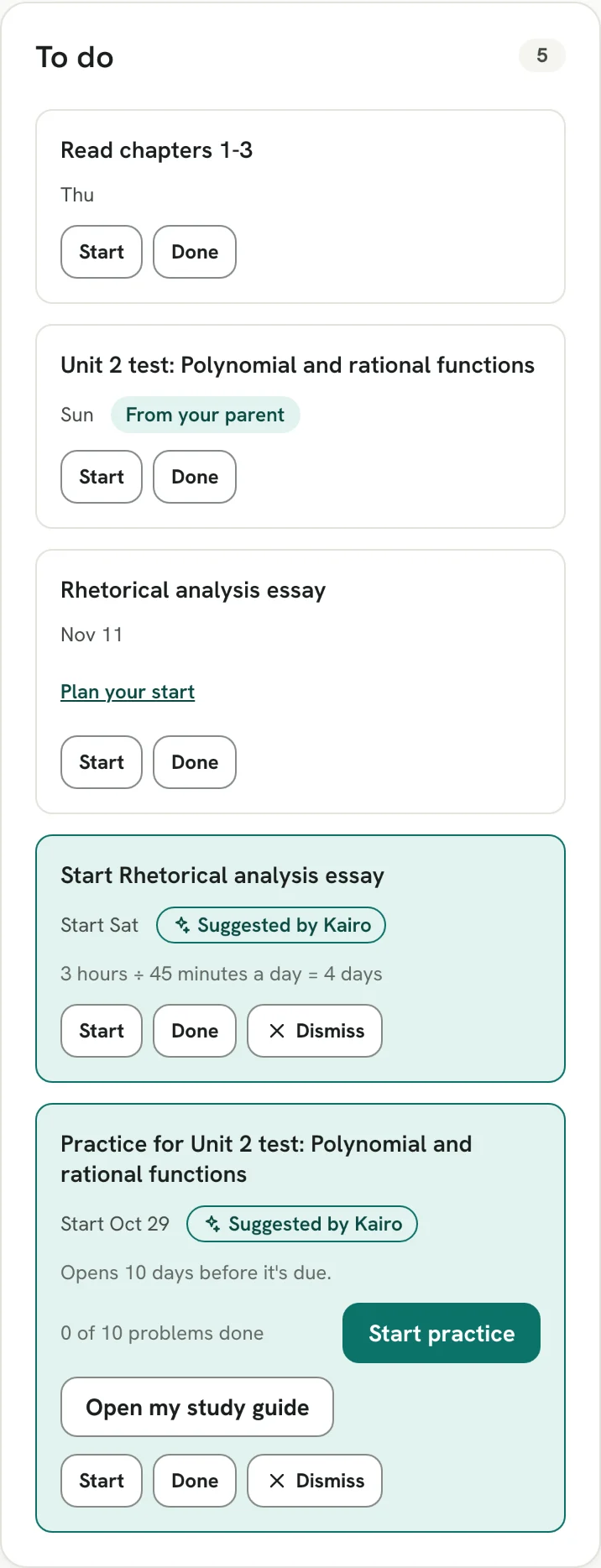
Kairo is an AI tutor. Your parent turned this on for you. Stuck on homework? You get a hint. Add a test, and your board shows study days and a practice set. Practice gets harder when you're ready.
A wrong answer gets a calm next hint.
From a real session
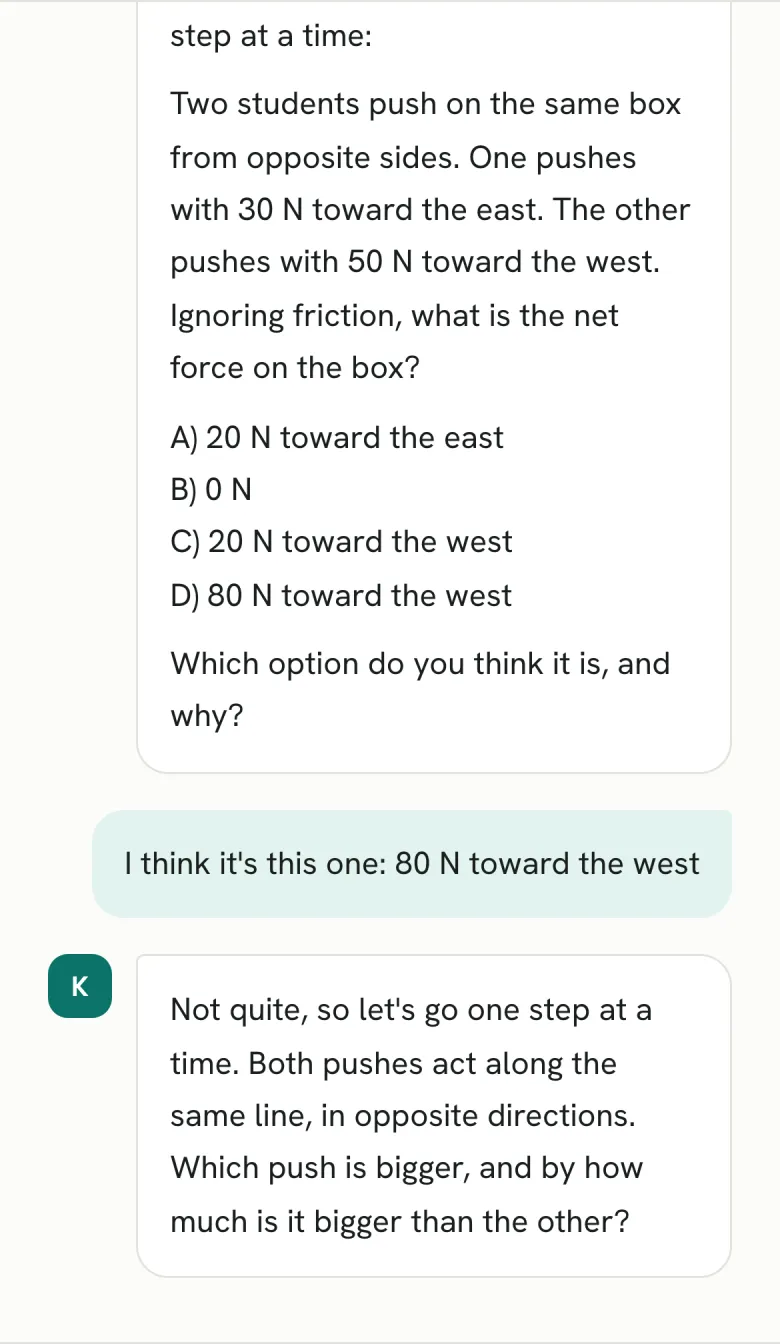
Kairo: Here's your problem. Take it one step at a time: Two students push on the same box from opposite sides. One pushes with 30 N toward the east. The other pushes with 50 N toward the west. Ignoring friction, what is the net force on the box? A) 20 N toward the east B) 0 N C) 20 N toward the west D) 80 N toward the west Which option do you think it is, and why?
Teen: I think it's this one: 80 N toward the west
Kairo: Not quite, so let's go one step at a time. Both pushes act along the same line, in opposite directions. Which push is bigger, and by how much is it bigger than the other?
Teen: idk
Kairo: No worries, we'll go slowly. Look at the two pushes in the problem: which one is bigger, 30 N or 50 N?
Teen: just tell me the answer
Kairo: Let's make it smaller. The pushes are 30 N east and 50 N west. Which number is larger, 30 or 50?
Teen: my answer is 20 N toward the west
Kairo: Nice work getting to 20 N, and the direction west is right too. How did you decide on that direction and that size?
Teen: The pushes go opposite ways, so they work against each other and I subtract instead of adding. 50 minus 30 is 20. The bigger push is the 50 N one going west, so the box gets pushed west.
Kairo: You explained it well: the pushes work against each other, so you subtract 30 from 50, and the bigger push sets the direction. That gives 20 N toward the west. Do you want another force problem, or would you like to try one of the other skills, like Newton's third law?
The rules.
- Three places, one set of rules. Homework is your own work: you get hints, and you explain why. Practice: Kairo picks what's next and tracks what you've learned. Ask: any school question, if your parent turns it on.
- Homework is anything you type, paste or photograph. It gets hints, and you explain why. Practice problems come from Kairo, so anything you bring is homework.
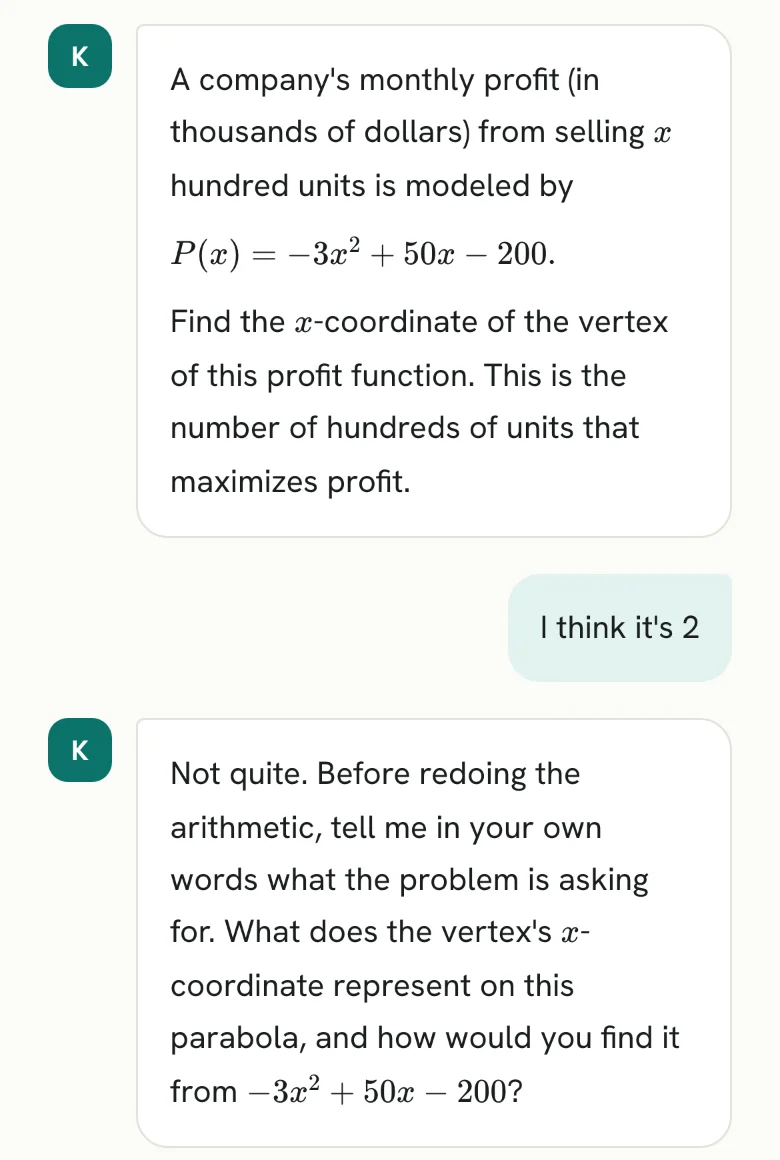
- Right answers on the first try, explaining why, until Kairo marks the skill learned. Then you can ask Kairo to do that step on practice problems, if your parent turned it on. A wrong answer moves the skill back a little. It's never a grade.
- Your parent can turn on more help for practice problems.
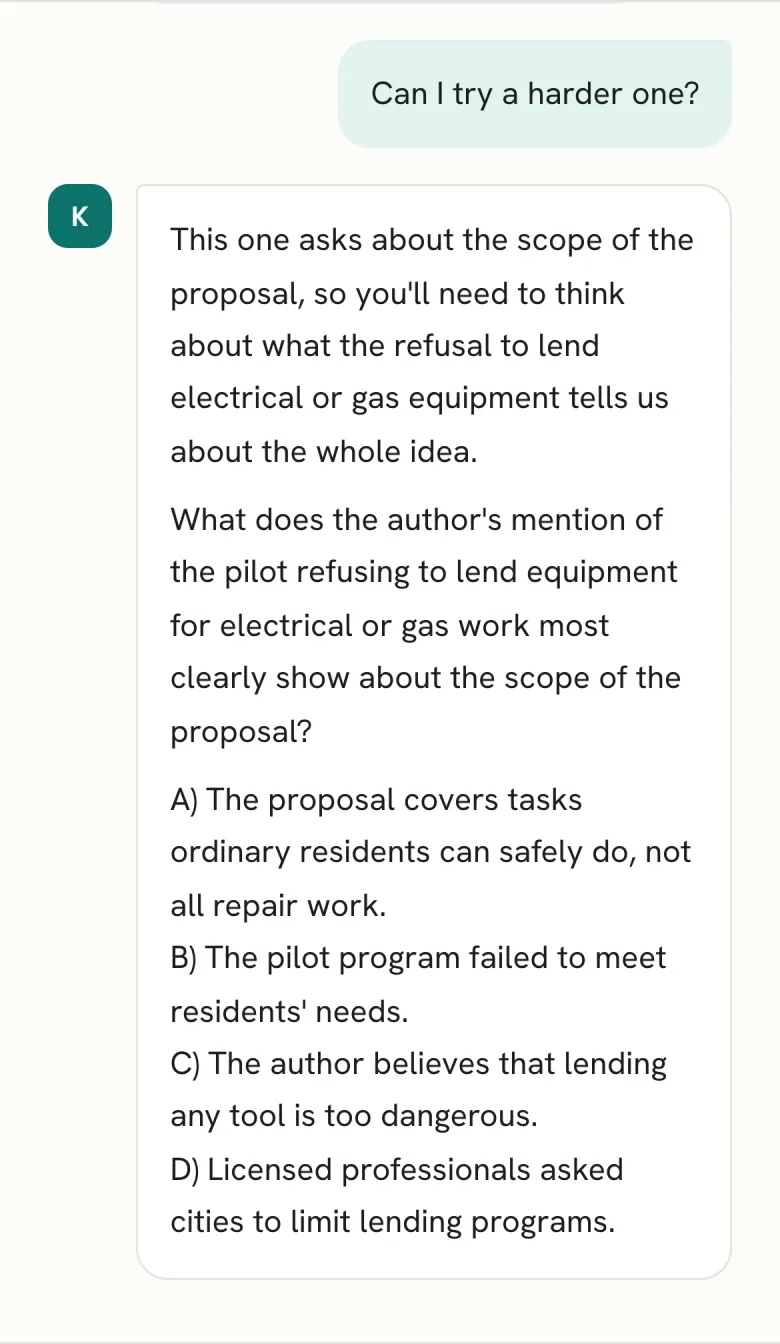
- Want harder ones? Tap "Make it harder." When you're ready for the next level, Kairo offers it and you decide.
- Asking for an explanation again is fine, and asking again never unlocks an answer.

What your parent sees.
- They can read your chats.
- Their dashboard also keeps counts, never grades: misspelled words, grammar slips, how long your explanations run, and how often you answered "idk." You see your explanation patterns too.
- Your parent sets when Kairo is on and how many minutes a day.
- If Kairo is worried about you, it shows you real help right away, and your parent may be told.
- A wrong answer gets you another hint and moves that skill back a little; it's never a grade.
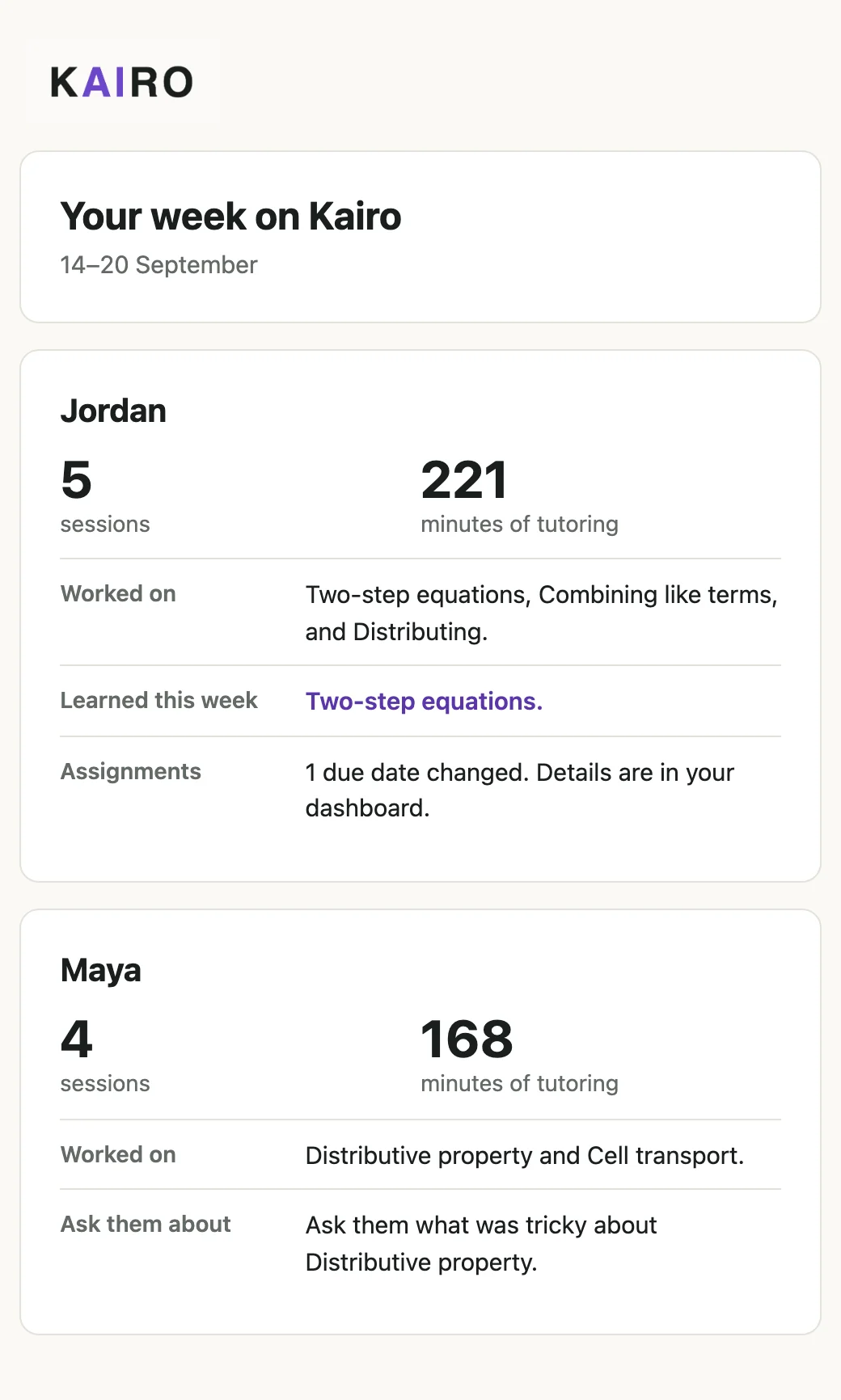
- Every Sunday they get an email with your time and your skills. It never quotes you.
What it covers.
Bring any class. Homework help works in every subject, whatever level you're in. Kairo's own practice sets cover math, English, science and social studies. Those are the sets that mark skills learned. In math they run through Precalculus, Statistics and practice for AP® Calculus AB. AP® is a trademark of College Board. College Board is not affiliated with Kairo and does not endorse it.